
Does your mask actually fit?
HEMA takes this question for granted and it's bad.

First of all, let’s address the obvious:
Fencing masks are made to prevent eye and facial injury from fencing foils and are not designed for percussive weapon contact.
At best, contact to the front mesh is tolerable, but the top and sides are absolutely insufficient for almost any level of contact.
Repeated sub-concussive impacts to the head absolutely add up over-time; while we don’t have HEMA-centric information, studies have been done from Kendo perspectives as shown here. It is unclear how masks interface with these types of data, force transduction, and long-term brain health.
As Instructors, student behavior should be monitored during intensive activities, and the club culture should be developed around making sure everyone can participate at contact levels for which they have consented.
As a student, you borrow the health and well-being of other students and Instructors to learn HEMA. You must practice into producing play-contact that all parties have consented to each drill or sparring exercise.
OK, now for the meat and potatoes!
As a 5’6” (167.6 cm for you metric folks) female-bodied person, getting into HEMA has always come with a bit of gear struggle. And while I have been relatively petite (less so 9+ years in), my mask has been the least of my worries most of the time. I use a small AF Deluxe with light modification to the “ear flaps”. One of our best local gear modifiers, Jeremy Halliday, developed the solution of adding snaps to the overlay to help it lay in a flat and relatively stable position, as shown.
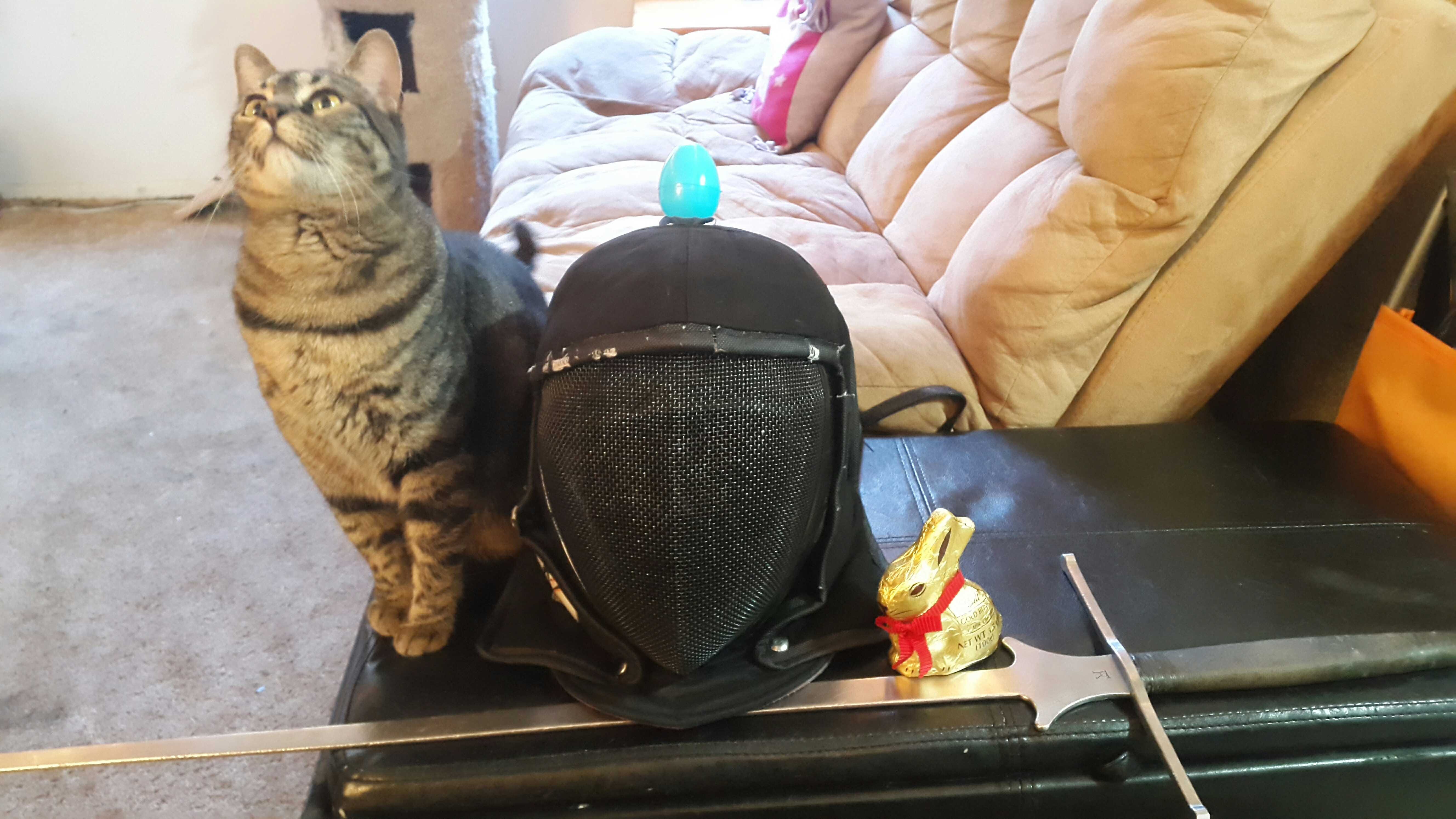
Photo credit: Me. Old mask used for an Easter photo shoot/activity. Cat tax included.
The mask shown here was retired after a particularly frightful failure: the weld holding the face frame and the side frame together had failed near my jawline on both sides. Jagged metal was sitting near my face for an unknown amount of time until the fit started feeling weird. A fresh mask was rushed to me in time for the next event.
When I acquired this mask, I was sent two by accident! Both smalls, both AF Deluxe.
The fit was wildly different between the two new masks, and no amount of squishing and adjusting addressed it.
For those who don’t know, you can compress the mask in either the vertical or horizontal plane to adjust the fit to the height of your head and relative head shape.
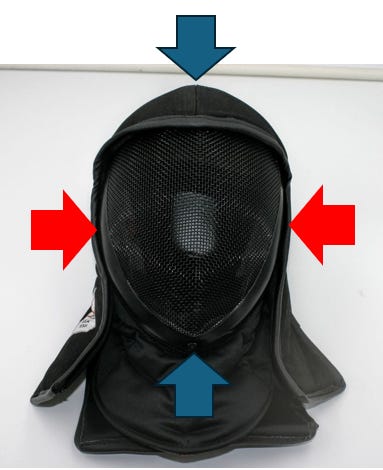
Photo: www.absolutefencing.com, modified with arrows depicting proper pressure points for fit adjustment.
I chose the mask that fit me best and sold the other for PHA.
This is not an uncommon occurrence. Depending how the liner gets attached during manufacturing, slight differences occur within a size.
Key aspects of a well-fit mask:
My chin and forehead contact the liners at all times and are “contained” by the material. I have plenty of both so this wasn’t a problem for me.
My head felt secure, without being compressed.
I could talk normally, in that my jaw wasn’t also compressed shut.
My face is retained away from the mesh ←— this is tragically important.
I could compress the rear tongue to maintain the pressure and secure the fit at the back of my head.
The mask turns with my head; my head does not rotate without the mask also rotating.
Key failures of an unfit mask:
Head and face float away from the padding causing potential contact chaos.
Face proceeds past the liners and contacts the mesh ←—Called a waffle in the community, due to the imprint/damage left on one’s face, typically the nose bridge, brow, or cheek.
Head turns without mask, reducing what little protection it lent initially.
Excessive injury, neck strain, and otherwise bad times for the user.
I wanted to mention waffles specifically, because while they are typically attributed to an “excess of force”, almost every occurrence I have witnessed has been accounted for by an ill-fitting mask (probably 90/10 fit vs force ratio):
- A person who’s head/face is smaller than the mask liner will have their mask slide backward under any type of force, and their face will make contact with the mesh.
- A person’s mask has degraded or the liner had ripped, causing a similar failure.
While poor mask fit can affect anyone, certain populations see higher instances of head injury because of this. If you are petite bodied, or are otherwise a smallish human, have a small head for your body size, have an oddly-proportioned noggin, you may have a compromised mask fit.
Another factor that doesn’t get a lot of attention is mandibular surface area, aka your chin/jaw line. When you factor in mask/bib material, jacket collar, and gorget type, you may not have enough forward jaw protrusion left to properly seat your mask. A mask should sit close to your throat without choking you or putting undue pressure on throat structures.
I see so many masks at events sitting entirely at the wrong angle, canted backward, with a person’s forehead falling forward and their chin disappearing somewhere behind the main rim.
Yet another concern that haunts my event-running anxiety dreams: So many small bodied (yes, mainly female-identifying but not exclusively) persons whose head posture becomes crowded out by material. (This will be a whole future topic: Surface Area to Volume ratio of gear)
How Do We Do Better???
If you run a club/school, every beginner needs a dedicated lesson in how to fit a mask, what it can and cannot do, how to make adjustments, and what failures to watch for.
If you are joining a club/school, try on masks if they are available to begin honing your sizing.
Some schools have the ability to outfit their students and hopefully complete a fit check before assigning a person a mask.
Spread awareness kindly when you see a mask that is likely a poor fit. Some folks arrive to HEMA entirely unaware of how poorly their gear fits. This is awful at events and happens EVERY SINGLE EVENT.
How to fit check:
Provide students several sizes of mask of the same model to try on.
Show them how to make gross fit adjustments for their head shape by linear compression, per the image above.
Perform a Push-test, applying pressure to the mesh toward their face, to see if their forehead or chin slides forward easily ←- if so, likely size down.
Depress the tongue and have them move their head; ensure the mask travels with the head and face direction.
Make sure it is comfortable enough, they don’t feel overly compressed but the mask feels secure, and it does not choke at their neck.
Avoid filling in gaps to “make it work” ***
Glasses may need more lateral room for persons who require them. This should not eliminate other fit factors but it can compromise some. Encourage contacts or prescription sport goggles for persons needing corrective eye-wear. Or suggest they fight blind with fuehlen. I’ve seen it before.
*** Many folks use a gel cap liner, rugby cap, or other head scarves or coverings to adjust for poor mask fit. This should be considered a stop gap only and should not be a solution for true fit. These often do not solve the physics problem of a too small head/face impacting the mesh.***
Side Items:
The liner used in masks will often retain bacteria causing acne. Wipe out mask liners after every use. The type of sanitizer used can also cause skin irritation or acne, so be mindful if you are developing acne on the chin/jaw line or forehead. Abrasion can also cause irritation and acne.
Sweat management means bandanas or other materials worn between you and the mask; regard your fit accordingly.
Overlays don’t typically affect fit, but they can affect your overall comfort with heat, hearing, weight and head posture. We’ll cover overlays in the future.
Extra padding can and should likely be added where allowable. I add extra foam between my overlay and mask; I have added some inside in the past, lining the back ridge near the skull.
But Kirsten, I already bought a mask and can’t afford another!
-Completely understandable. Save up for a new one, sell the bad fit one.
This mask is a sentimental hand-me-down from a dear friend!
-Cool, don’t bring it to tournament or trust your brain health to it unless you both have the same sized head. Clean it out good too.
This is all my club has!
- Ask them to provide something that works better/make them aware nothing is available to protect you. They should care way more about your head health.
But I’ve only had this for X years!
-If you are years into this hobby and are still wearing a bad fit mask, A: I’m sorry, B: It probably needs retirement anyways depending on your contact activities. You need a mask that fits right.
But the XS AF mask has a white bib!
-I know. Looks awful doesn’t it? It still looks better than a bleeding head wound.
Casually writes a thesis paper on mask fit as the first post. Very well done, thanks for the notes and helping to keep this sport safe and accessible to all.